
Many people who have heard of QFD (Quality Function Deployment) would like to understand more about this powerful tool. This article/case study serves as an introduction to the basics and provides a simple example application of QFD. Later, you can build on this according to your needs. Below is an empty first house of quality – or as it is often referred to, “House 1”. Initially, a House of Quality can be a bit daunting, but it is not as difficult as it looks. After reading this article, you will be well on your way to using this powerful tool.
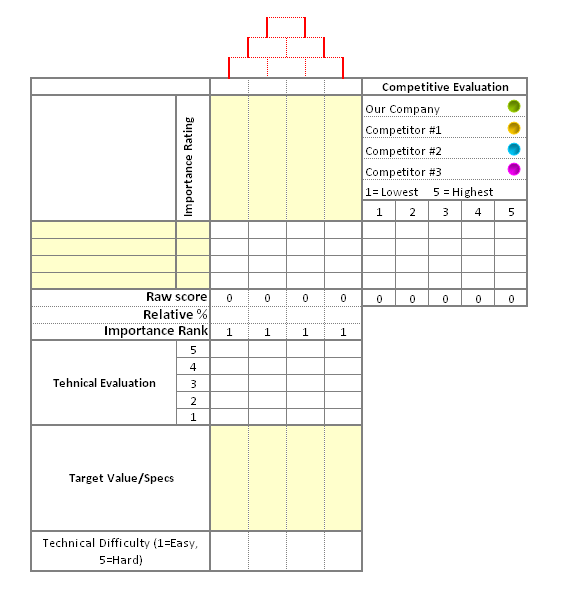
Many people have difficulty learning from theory alone; for that reason, it is often helpful to clarify a new concept by using an example. Since this article is “general” – that is, it isn’t product design oriented, IT centric, or project management specific – I chose a project that most of you have dealt with in the past: the Summer Vacation. Without doubt, a summer vacation is a project that presents parameters involving specific requirements and desires. Because you have probably encountered this process on more than one occasion, hopefully, you can relate. It might also provide a bonus; perhaps it will assist in avoiding a disastrous vacation. In the summer of 2007, my wife and I were planning our summertime family vacation. We decided to take our two children to the Florida Keys for one week. Of course, going on vacation isn’t as simple as merely throwing some clothes in a suitcase and heading for the beach. Worst case scenario: after a 6 hour car ride, you discover you are missing your child’s favorite stuffed animal, setting the tone that the week will be unpleasant at best. To avoid this, we use QFD to ensure we will meet our requirements. To keep this example short, I have left out a few of the requirements, but you should be able to follow the methodology easily.
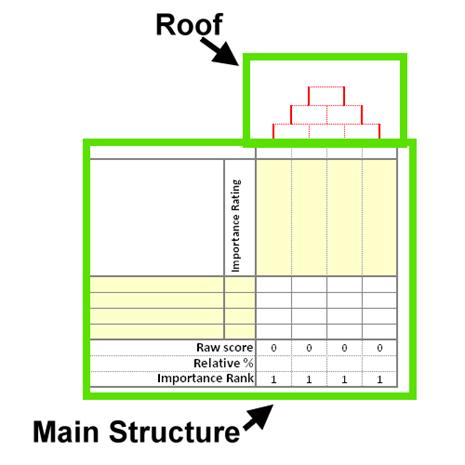
In this article, instead of using the full QFD matrix, we are going to get our feet wet with a reduced matrix which includes the “Main Structure” and the “Roof” (see below). Future articles will address the omitted sections.
Step #1: Gather the Requirements
One of the objectives of QFD is to make sure that all of the customer’s goals (in this case my family’s goals) or requirements are met. Of course, to meet the customer’s requirements you must first gather the requirements. One of the most commonly reproduced mistakes when implementing QFD is either to skip this step or not perform it fully. To ensure you are meeting your customer’s requirements, you must first identify the customer. Thus, before leaving the requirements-gathering phase you should be able to answer these two questions.
Who are my customers?
What do they want from the product/service/process?
My intent with this article is to introduce QFD and not delve into multi-dimensional market segmentation, so I will simply answer the first question as…
Who are my customers?
Answer: My customer(s) is myself, my wife, and my two children.
In the world of QFD, my family is dubbed the “market segment”, and we are targeting this market segment with our QFD. Within a segment, you will have more than one voice. Another common mistake in QFD is to listen to one customer within a segment and assume he or she speaks for the entire segment. In planning a family vacation, my wife’s and children’s needs should be considered. Starting with the first voice (mine) I need to ask myself the following question:
What do I want from this vacation?
Answer: I would like the vacation to be affordable and I would like to avoid repeated questions along the lines of, “Daddy, are we there yet?” I will shorten these to the requirements “Affordable” and “Painless Trip”.
However, when I asked my wife what she wanted from this vacation, she answered, “I don’t want to be stressed.”
When I asked my children, they both answered unanimously, “We want to have fun!”
At this point, I want to stop for a moment and discuss the importance of what just occurred. We as humans have a tendency to consider what we want or perceive to be important as actually being the “key requirements”. It would be easy for me to dismiss my kids with “Vacations are always fun” or “Who couldn’t have fun at the beach” – no future action required. Similarly, I could dismiss my wife’s concerns with “Once you get to the beach, all your stresses will melt away.” Whether you are utilizing QFD for vacation planning, the design of a new MP3 player, or a new loan approval process, you must fight this natural tendency to consider your thoughts/desires/ideas as more important than the customer’s.
At the end of this phase, my requirements list boils down to: Affordable, Painless Trip, Worry Free, and Have Fun.
QFD Key #1: Ensure you know who the customers are for the product, service, or project. Work to obtain requirements from a representative sample (multiple customers) within the targeted market segment. Strive to gather all the requirements and do not dismiss requirements that differ from your own.
Step #2: Insert Whats and Importance Ratings
We can’t start filling out the 1st HOQ without first understanding a little about it. Below is a picture of the typical view of House #1. On the left hand side go the Whats and across the top go the Hows.
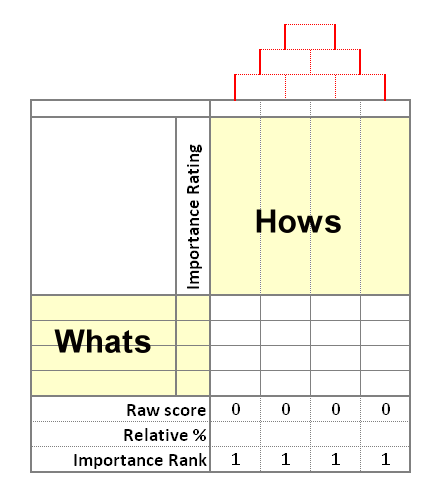
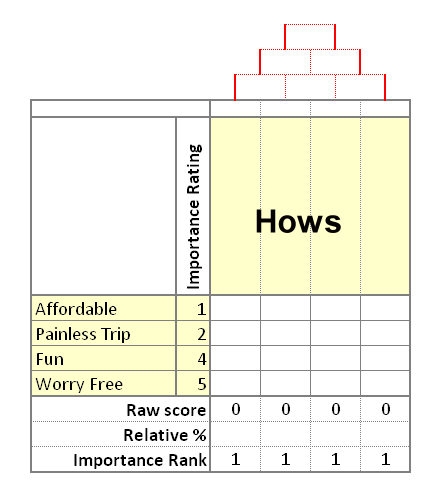
In this case, the Whats are my requirements (Affordable, Painless Trip, Fun, and Worry Free), which I gathered in Step #1. The matrix below shows House #1 with the Whats completed.
We are now ready for the “Importance Rating”. The Importance Rating allows us to prioritize the requirements. Typically, a 1 through 5 scale is used with the most important requirement assigned a value of 5 and the least important requirement assigned a value of 1. In our case, the requirement to be “Worry Free” came from my wife, so it clearly gets the “5” and my requirement to be Affordable is assigned a rating of “1”. There are more rigorous methods to rank order priorities, such as pairwise comparison, but we shall leave that for a later article. Our House #1 now looks like the following.
Step #3: Brainstorm “Hows” and Enter in Top Row
Now that we have established the Whats, we need to answer the question “How?” This is typically a brainstorming activity that is best done with the customer. In order to complete the Hows, ask yourself the following question:
How will I ensure all of the Whats are addressed (will occur)? In other words, what steps/actions/goods/services do I need to perform/acquire/purchase to ensure that the Whats are all met?
Let’s start with our first “What” – “Affordable”. I need to know, How can I ensure the vacation is affordable? This leads to another QFD key.
QFD Key #2: Avoid the temptation to make the top of House #1 too detailed.
I could easily start listing things like, “Inexpensive Hotel”, “Turn off Air Conditioner while gone”, “Cook meals in room”, etc. Instead, I will condense all of this into a simple statement: “I would like the vacation to cost less than $1,000”. My “How” is to keep the total cost of the vacation under $1,000 (in later articles we will address how to do this with House #2).
I then moved onto my second requirement: Painless Trip. The question that needs to be answered is “How can we make the trip to the Florida Keys painless?” This leads to more questions like “What makes trips painful?” and “Whose pain are we referring to?” The result of our discussion was that car games are fun for children for about two hours; after that they start in with “Are we there yet?” And, as those of you with children know, the affect worsens as the children tire. Therefore, the answer to the question “How will we have a painless trip” is “Leave prior to 10am with DVD player in car”. The “leave prior to 10am” part ensures that we arrive in the Keys before the children get tired, and “with DVD player in car” ensures that the kids have something to do other than find all the letters of the alphabet on license plates.
My third requirement was for the vacation to be “Worry Free”. I need to answer the question… “How can I make the vacation worry free?” This leads to another key of QFD.
QFD Key #3: Customer involvement is critical in the success of any QFD implementation. Conversations with your customer become more productive when you attempt to understand their requirements in greater detail.
For example, I need to understand the elements of vacation that “worry” my wife. It turns out that the worry is centered on forgetting something the previously mentioned favorite stuffed animal, allergy medicine, snacks for the car, to turn off the oven, etc. Once I understand this, the answer to “How can I make the vacation worry free” becomes “Make and use a pre-departure checklist”.
My fourth requirement, to have “fun”, probably seems like the easiest but turns out to be the hardest. I need to answer the question “How do we have fun on vacation?” To be completely honest, I failed to answer this question on far too many vacations. My initial reaction was to “do stuff in the Florida Keys”. One of the reasons for going was to visit a friend who had recently moved to Key West. I needed to add to this limited list or the vacation would rapidly become boring. After a quick internet search, I found a Turtle hospital, as well as a marine center called “Theater of the Sea”. At this point, my activity list resulted in the following.
- Visit friend in Key West (1 day)
- Turtle hospital (2 hours)
- Theater of the Sea (1 day)
We have 7 days of vacation planned and less than three days of activities available. My “Have fun” is in jeopardy. This leads to yet another key.
QFD Key #4: QFD can keep you from pursuing products/projects/processes that are not feasible. It is entirely possible that the product/project/process cannot meet all of the Whats. This is seen as a negative by many, but I would much rather go in with eyes wide open. When this happens, we can reduce the requirement set (make a smaller market segment happy), abandon the project, or look for a new and innovative way to make the Whats feasible.
Luckily, another solution presented itself. It turns out that most of the activities in the Keys revolve around fishing and snorkeling/diving. Since we recently purchased a boat, the options of activities expanded to include general boating (exploring the islands), fishing, snorkeling, tubing, and wakeboarding. Thus, the “How” becomes “Take boat and local activities”.
The current state of House #1 is shown below. Note that the Whats are on the left side and the Hows are across the top.
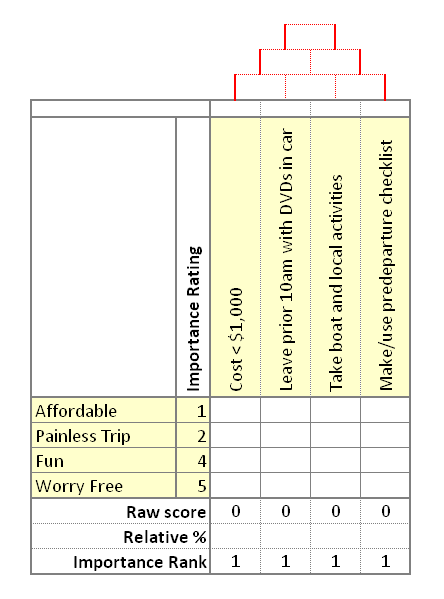
Step #4: Fill Out the Roof of House #1
The intent of the roof of House #1 is to note when requirements are correlated. Requirements are correlated when they tend to go up and down together. For example, “Cost < $1,000” and “Take boat and local activities” trend together. That is, as we take our boat and do local activities, the cost will go up. Since an increase in the use of the boat is desirable and an increase in cost is not desirable, they are negatively correlated. For this reason I have placed a “- -“ in the intersection between the two columns. The “- -“ signifies that these two Hows are highly negatively correlated. This leads to yet another key.
QFD Key #5: Correlations serve as early warning for Hows that might not be feasible. It may not be possible to take the boat and still have the vacation come in under $1,000. Understanding this now warns us of this possibility so that we can do additional investigation and prevent an unwelcome surprise later.
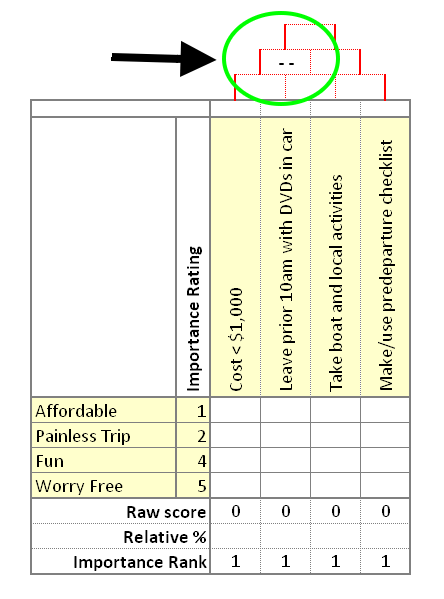
Step #5: Complete the Correlations
At each intersection of the Whats and Hows we need to put in a correlation. In this phase we ask ourselves the question, “To what degree does the How fulfill the What?” The correlations are typically defined as …
Strong Correlation = 9
Moderate Correlation = 3
Weak Correlation = 1
No Correlation = 0 (or blank)
The first pass of correlations is trivial. Each How which was included specifically for a What typically has a strong correlation. For example, to what degree does “Cost < $1,000” fulfill the requirement to be affordable? Since we created “Cost < $1,000” this should be a correlation of 9. After our first pass, we have the following House #1.
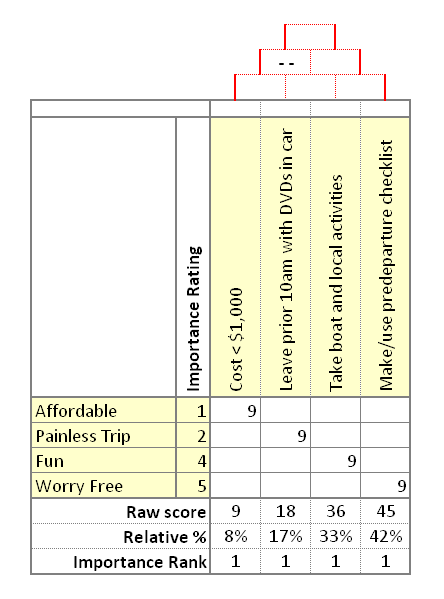
Before we move on, there might be some additional correlations to consider. We should look at each of the intersections to determine if there are other correlations. For example, to what degree does “Make/use pre-departure checklist” correlate to “Painless trip”? In other words, will the checklist serve as more than just a way to facilitate “Worry Free”? In this case, we decided that it would. The creation of the checklist will ensure that we don’t forget key items that would be required on the trip (DVDs and snacks, for example). For this reason, we assigned this a value of 3. At this point, we have the following House #1.
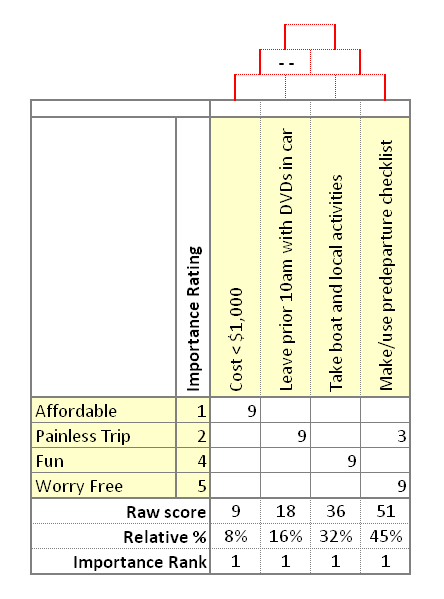
At the bottom, we need to calculate a Raw Score. The Raw score is the sum of the product between the importance rank and the correlation. Quantum XL calculates this value automatically and will also calculate the Relative %. The Relative % is the percentage of the total score that each Howcontributes. In this example, the total Raw Score is 9 + 18 + 36 + 51 = 114. The Relative % for “Cost < $1,000” is 9/114 or 8%.
Step #6: Inspect Results and Edit as Required
We need to take a quick look at our house to ensure that there are no glaring problems. Three key items to check for are…
- Rows without correlations. If a row (What) is completely empty, then we are missing a How. This might be a clerical error or worse; it might be that we can’t fulfill the What.
- Columns without correlations. If a column (How) doesn’t have a correlation, again, it might be a clerical error. But if it is not, then do we need that How?
- Are we missing any Whats or Hows? In the process of creating this first house, you probably will discover some additional customer requirements. If this happens, add some rows. Quantum XL makes adding rows and columns easy – and with no loss of data.
Step #7: Pareto Results
Quantum XL will create a Pareto of the Raw Scores for us. The resulting Pareto for our example is below.
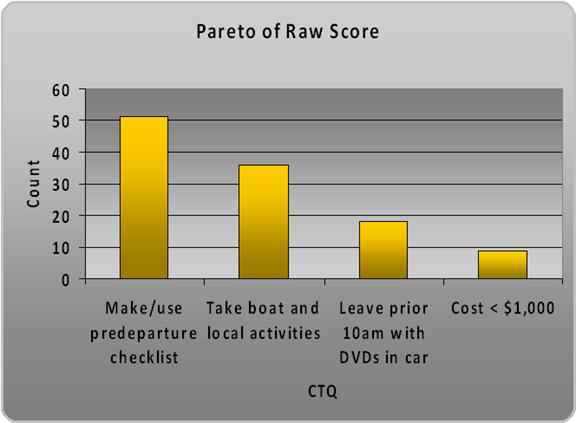
Many people are tempted to refer to this as the “Answer” resulting from QFD. This perspective is definitely not correct and/or greatly reduces the benefit of QFD. This leads to another QFD Key.
QFD Key #6: The entire matrix and the journey are the deliverable from a QFD. If we had not gone through the QFD process, I wouldn’t have considered making a pre-departure checklist, taking the boat, or leaving prior to 10am with DVDs for the Kids. Granted, given the Pareto we definitely don’t want to forget to make the checklist. However, the entire house, Whats, Hows, roof, correlations, Pareto, and the journey are all the deliverable or “answer” from the process. We have a much better understanding of our market segment and what will lead to a successful vacation.
Step #8: Move to HOQ #2 (as required)
In some cases we might need to take a How or combination of Hows and break them down further. Take for example the requirement “Cost < $1,000”. Sounds great, but how do we make this How happen? That is the goal of the next house and another article. The general approach is to start a new HOQ, making the How from House #1 the What in in House #1.
I hope that this has helped you understand the power of QFD. We believe that QFD is exceptionally important any time you are designing a product, creating a new process, or starting a project. To take the complexity out of software usage, we created Quantum XL which allows you to set up and modify QFD houses with little effort. As a result, you can focus your time and energy on the process instead of the software.
About Quantum XL
Quantum XL is an easy-to-use Excel add-in which makes creating and changing houses of quality easy for everyone.
For more information about Quantum XL, please visit http://www.sigmazone.com/QuantumXL.htm.
SigmaZone.com is a leading provider of statistical tools, training, and consulting, serving businesses across diverse industries since our inception in 1992. Our solutions have delivered business results, return on investment, and quality improvements in thousands of companies around the world.
By the way, you might think I never actually used QFD or took this vacation. Wrong. While I did change a few of the numbers (my budget goal was a little higher than $1,000) I did take my family to the Florida Keys. An added note: If your kids like animals, I highly recommend the Turtle Hospital on Marathon Key (http://www.turtlehospital.org/). The only way to see the turtles is to call ahead and make a reservation for one of their tours.
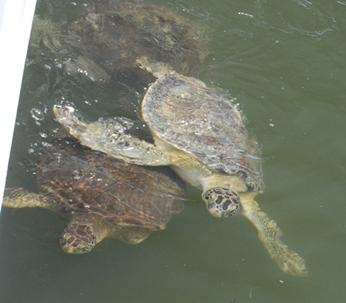
Theater of the Sea (www.theaterofthesea.com) is also enjoyable; however, I would plan on a half day as opposed to the full day previously mentioned.



Finally, the fishing, boating, and water sports are always excellent. The water is extremely flat in the keys. The typical wave that forms next to land is practically non-existent, which makes boating on the ocean much less rough than in most other locations.



Download this article in printer friendly pdf format
Heya i’m for the first time here. I came across this board and I in finding It really useful &
it helped me out much. I hope to give something again and aid others such as you helped me.